So beautifully that we've started to believe prediction is comprehension — that fluency is intelligence. The infrastructure required is concentrated in a handful of companies, in a handful of countries, consuming resources at a planetary scale.
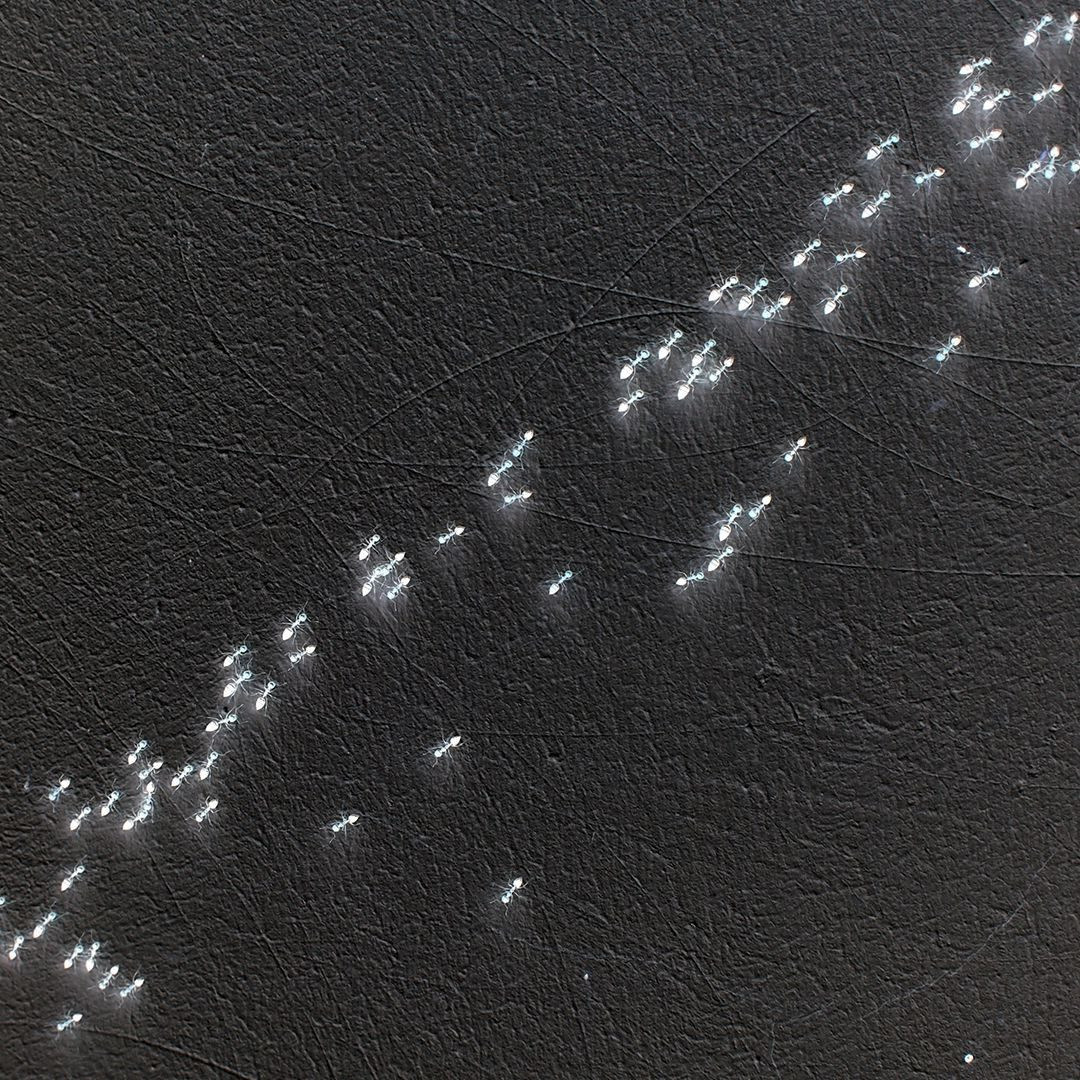
No training data. No parameters. No prompts. The ant doesn't understand what it's doing. It doesn't need to. The slime mold grew the Tokyo rail network — using chemical gradients alone — before human engineers solved the same problem.
Not AI that talks about navigation, but AI that navigates. Not AI that describes adaptation, but AI that adapts. Physical signals. Simple rules. Distributed authority. No cloud. No model. No language.
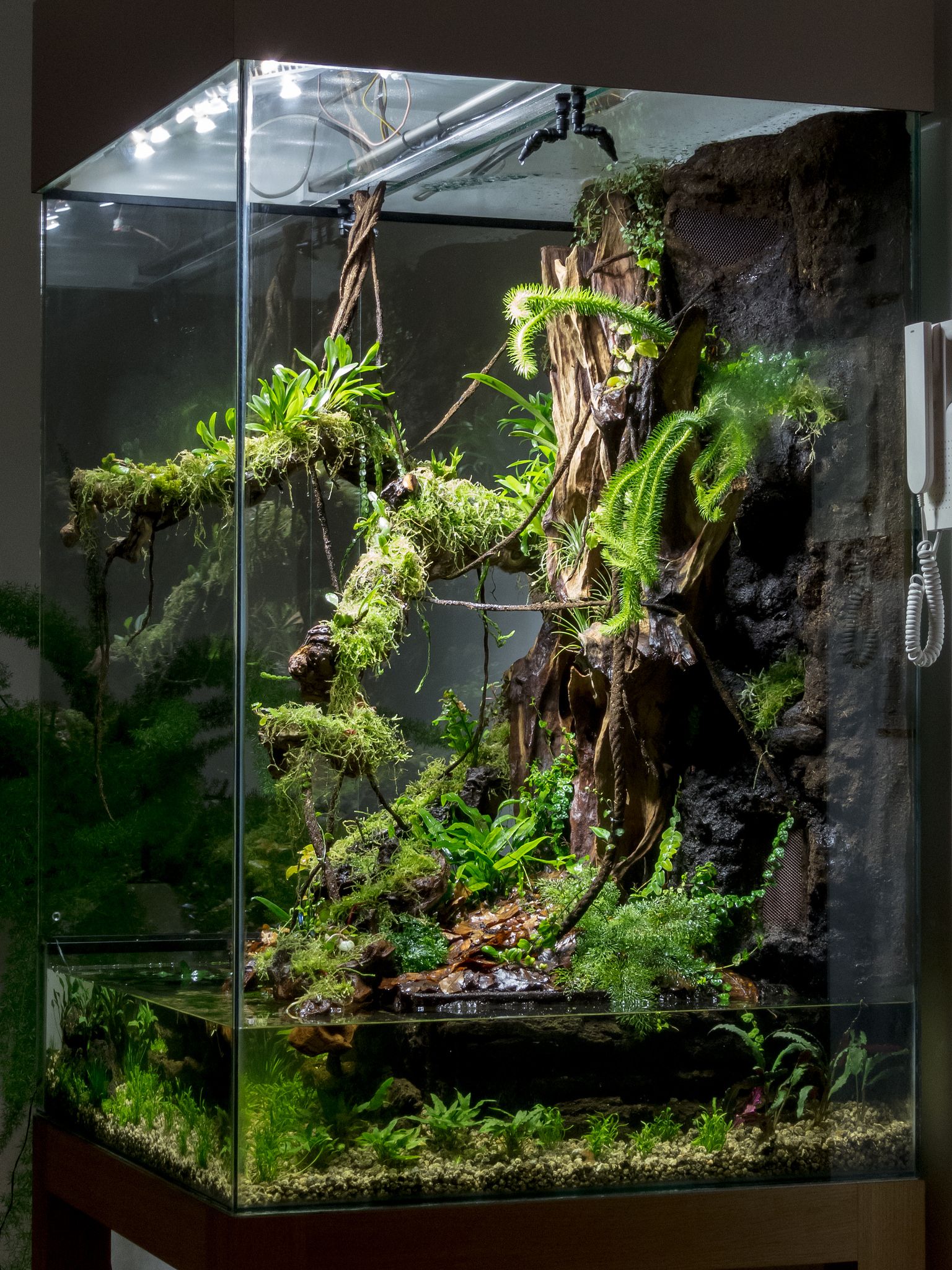
Twelve autonomous rovers navigate an enclosed glass habitat — finding energy, avoiding a predator, rebuilding paths as the terrain is reshaped around them. They carry TinyML neural networks so small they fit in 100 kilobytes. Models that don't predict words. They predict: Is this signal getting stronger? Should I turn left? Is this charging station worth the risk?
Day one, the rovers wander. They bump into walls. They miss charging stations. Week two, something happens. Routes get smoother. Stations get found faster. The predator gets avoided more often. Not because anyone programmed better behavior — but because the tiny networks learned from failure. From the environment itself.
Inquire about placement →
Seeking museum, gallery, and academic institution placement for 2026–2027. Please reach out to discuss the installation, loan, or exhibition opportunities.
The same principles that govern the physical installation — pheromone gradients, BOIDS flocking, emergent path-finding — run live in your browser. Configure a colony. Watch behavior appear that you did not program.
Spin up a flock of 50 worker drones and 3 hopper scouts. Set exploration to High. Watch the swarm spread outward, mark food sources with ghost pheromones, then converge back to the queen carrying what it found. Switch to Ghost viz mode to see the communication network underneath.
A 2-week apprenticeship for students who want to understand intelligence before it learned to speak. No prerequisites. No coding required. Just curiosity and the willingness to watch a simulation fail.
What intelligence looks like when there is no language — and why that matters. Students spin up their first flock in SlimeHive and ask the fundamental question: where did the intelligence come from?
Thaler & Sunstein's choice architecture applied to swarm behavior. Students add attractors and obstacles and measure how the smallest environmental change steers collective behavior toward different outcomes.
Computer vision basics — how machines see without understanding. Students sketch what a CV system would see in their simulation. They compare machine perception to human perception and locate where they diverge.
Each student presents their SlimeHive capstone: explain the configuration, show the emergence, break it deliberately, and connect it to a real-world system. Understanding failure is the beginning of mastery.
This paper proposes NLM — Natural Language Modeling — as a framework for building adaptive, responsive, context-aware systems using only local physical signal processing. No transformers. No training data. No cloud dependency. Intelligence, in the NLM framework, emerges from what the Caribbean has always known: that who feels it knows it. We present two working proofs: SlimeHive and Ceiba. Neither contains a neural network. Neither requires internet connectivity. Both are alive.
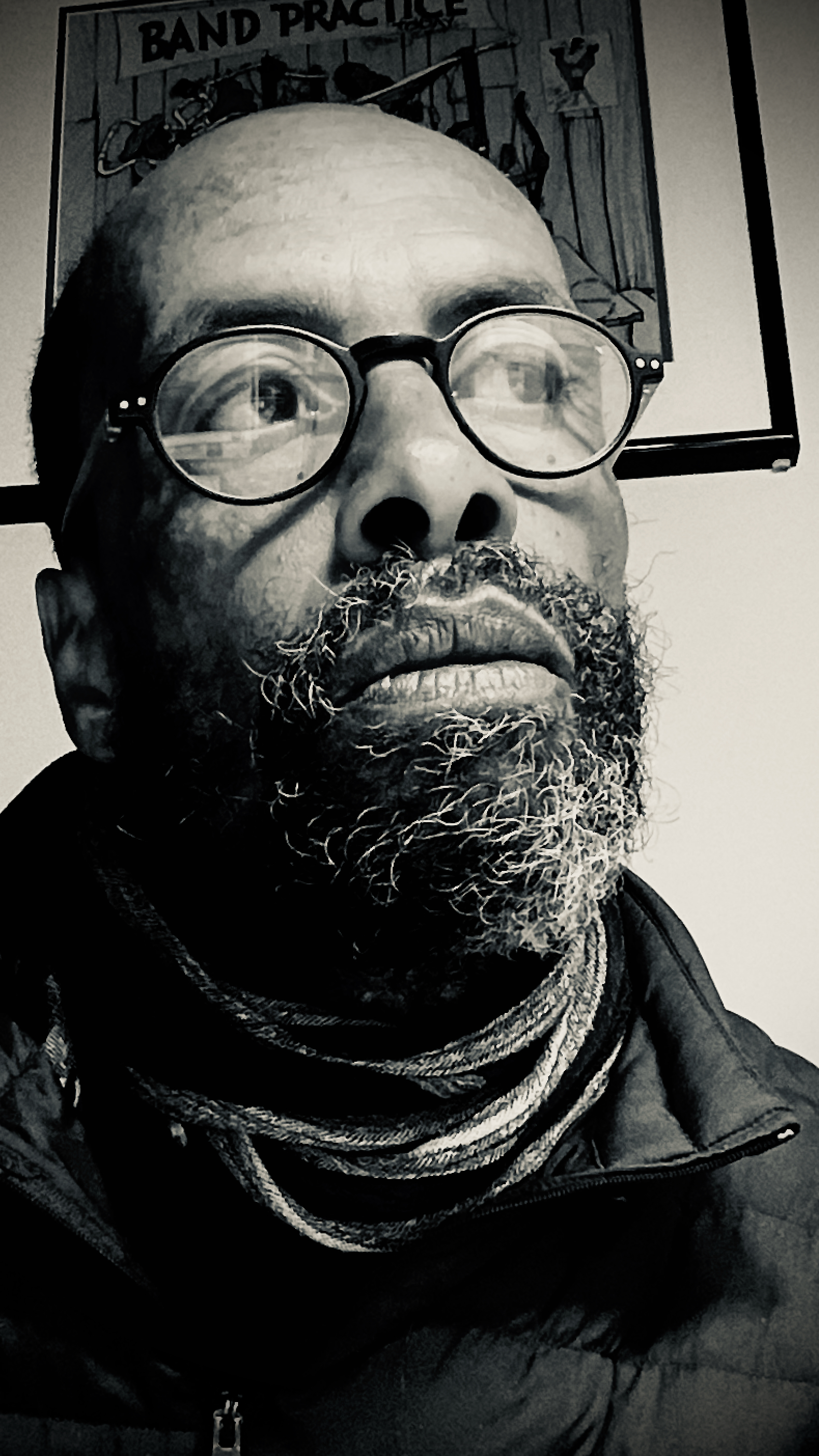
The author of this paper learned to code on a $35 Radio Shack computer in Charlotte, North Carolina. He was born in St. Croix, United States Virgin Islands. He has stood in Havana garages where mechanics kept 1930s automobiles running by fabricating parts from scratch — adapting, improvising, resolving. He has walked the souks of Marrakech where artisans transform discarded components into objects of precision and beauty. He did not wait for the technology to trickle down. He built with what was in front of him.
NLM is that instinct formalized into a methodology. SlimeHive is the proof of concept. Blacksky Labs is the practice — a design and research studio at the intersection of technology, culture, and the communities that built the modern world and were then told to wait for its benefits.